
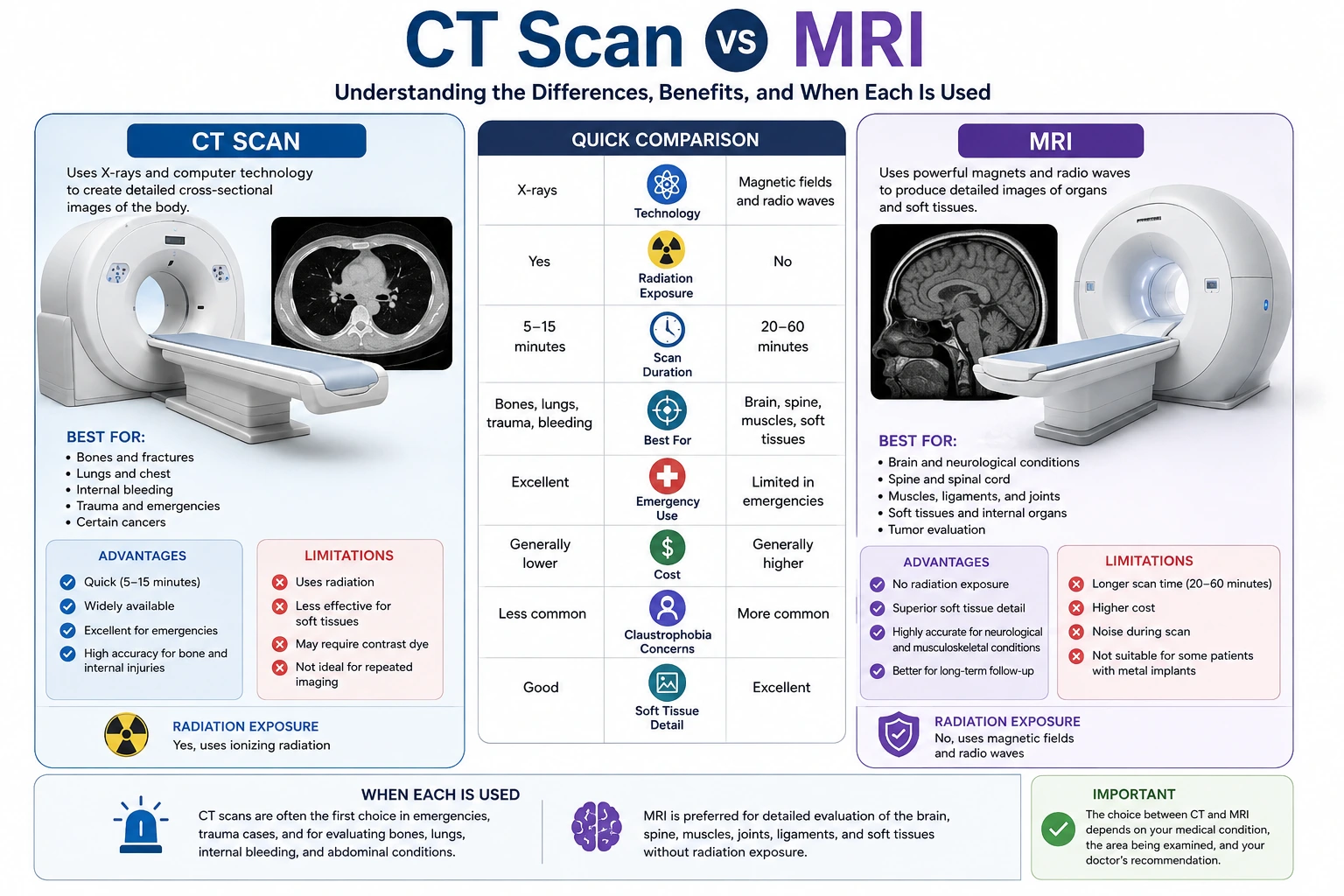
CT Scan vs MRI: Understanding the Differences, Benefits, and When Each Is Used
Medical imaging plays a crucial role in modern healthcare by helping doctors diagnose diseases, monitor treatment progress, and identify injuries with precision. Among the most commonly used imaging technologies are Computed Tomography (CT) scans and Magnetic Resonance Imaging (MRI) scans.
Patients are often confused about the difference between these two tests and may wonder which one is better. The answer depends on the medical condition being evaluated, the body part being examined, and the urgency of the situation.
Understanding CT Scan vs MRI can help patients feel more informed and confident when their doctor recommends an imaging study. In this guide, we’ll explain how each technology works, their advantages and limitations, common uses, safety considerations, and how physicians determine which scan is most appropriate.
What Is a CT Scan?
A Computed Tomography (CT) scan uses a combination of X-rays and computer technology to create detailed cross-sectional images of the body’s internal structures.
During a CT scan:
- Multiple X-ray images are taken from different angles.
- A computer combines these images into detailed slices.
- The images can be viewed individually or reconstructed into 3D images.
CT scans are particularly useful for evaluating:
- Bones
- Lungs
- Blood vessels
- Internal bleeding
- Trauma injuries
- Certain cancers
Because CT scans are fast and highly detailed, they are frequently used in emergency situations.
What Is an MRI?
Magnetic Resonance Imaging (MRI) uses powerful magnets, radio waves, and advanced computer software to generate detailed images of organs and tissues.
Unlike CT scans, MRI does not use ionizing radiation.
MRI is especially effective for examining:
- Brain tissue
- Spinal cord
- Muscles
- Ligaments
- Tendons
- Joints
- Internal organs
- Soft tissues
MRI provides superior soft tissue contrast, making it valuable for diagnosing neurological and musculoskeletal conditions.
CT Scan vs MRI: Quick Comparison
| Feature | CT Scan | MRI |
| Technology | X-rays | Magnetic fields and radio waves |
| Radiation Exposure | Yes | No |
| Scan Duration | 5–15 minutes | 20–60 minutes |
| Best For | Bones, lungs, trauma, bleeding | Brain, spine, muscles, soft tissues |
| Emergency Use | Excellent | Limited in emergencies |
| Cost | Generally lower | Generally higher |
| Claustrophobia Concerns | Less common | More common |
| Image Detail for Soft Tissue | Good | Excellent |
This comparison highlights why the choice between CT Scan vs MRI depends on the patient’s specific condition.
How Does a CT Scan Work?
A CT scanner consists of a large circular machine with a rotating X-ray tube.
The process includes:
- The patient lies on a motorized table.
- The table moves through the scanner.
- X-rays rotate around the body.
- Data is processed into cross-sectional images.
Advanced CT scanners can capture detailed images within seconds.
Advantages of CT Scans
- Quick imaging
- Widely available
- Excellent for emergencies
- High accuracy for fractures
- Effective for detecting internal bleeding
- Useful for cancer staging
Limitations of CT Scans
- Uses radiation
- Less effective for certain soft tissue evaluations
- May require contrast dye
- Not ideal for repeated imaging over time
How Does an MRI Work?
MRI scanners use strong magnetic fields to align hydrogen atoms in the body.
Radiofrequency pulses are then applied, causing these atoms to produce signals that are converted into detailed images.
The procedure involves:
- Lying on a narrow examination table.
- Entering the MRI machine.
- Remaining still throughout the scan.
- Receiving detailed images of internal structures.
MRI scans often take longer than CT scans but provide exceptional soft tissue detail.
Advantages of MRI
- No radiation exposure
- Superior soft tissue visualization
- Highly accurate for neurological disorders
- Excellent for joint and spinal evaluations
- Better differentiation of tissue abnormalities
Limitations of MRI
- Longer scan times
- Higher cost
- Noise during examination
- May cause discomfort for claustrophobic patients
- Not suitable for some patients with metal implants
CT Scan vs MRI: Which Provides Better Image Quality?
The answer depends on what is being examined.
CT Scan Produces Better Images For:
- Bone fractures
- Lung conditions
- Chest injuries
- Internal bleeding
- Kidney stones
- Trauma assessments
MRI Produces Better Images For:
- Brain disorders
- Spinal cord conditions
- Ligament injuries
- Muscle tears
- Joint abnormalities
- Tumors involving soft tissues
When comparing CT Scan vs MRI, MRI generally provides greater soft tissue detail, while CT excels in evaluating bones and emergency conditions.
Conditions Commonly Diagnosed with CT Scans
Doctors frequently order CT scans for:
Head and Brain Conditions
- Stroke evaluation
- Brain injuries
- Skull fractures
- Brain bleeding
Chest Conditions
- Lung infections
- Pulmonary embolism
- Lung cancer
- Rib fractures
Abdominal Conditions
- Appendicitis
- Kidney stones
- Liver disease
- Pancreatitis
Trauma Cases
CT scans are often the first imaging choice for accident victims because they quickly identify life-threatening injuries.
Conditions Commonly Diagnosed with MRI
MRI is preferred for many soft tissue and neurological disorders.
Neurological Conditions
- Brain tumors
- Multiple sclerosis
- Epilepsy
- Stroke follow-up evaluation
Musculoskeletal Disorders
- Torn ligaments
- Meniscus injuries
- Tendon tears
- Sports injuries
Spine Disorders
- Herniated discs
- Spinal cord injuries
- Nerve compression
- Degenerative spine disease
Cancer Assessment
MRI can help determine tumor size and involvement of surrounding tissues.
CT Scan vs MRI for Stroke Diagnosis
Stroke evaluation often requires both technologies.
CT Scan
Usually performed first because:
- It is fast.
- It identifies brain bleeding immediately.
- It guides emergency treatment decisions.
MRI
May be performed later to:
- Assess brain tissue damage.
- Detect small strokes.
- Evaluate long-term neurological effects.
In emergency stroke care, CT is often preferred initially.
CT Scan vs MRI for Cancer Detection
Both scans play important roles in cancer diagnosis.
| Cancer Evaluation | CT Scan | MRI |
| Detecting Tumors | Excellent | Excellent |
| Assessing Spread | Excellent | Good |
| Soft Tissue Detail | Moderate | Excellent |
| Treatment Planning | Good | Excellent |
| Follow-Up Imaging | Common | Common |
The choice depends on cancer type and location.
Radiation Exposure: CT Scan vs MRI
One of the most important differences is radiation exposure.
CT Scan
CT scans use ionizing radiation.
While the amount is generally considered safe, repeated exposure may increase long-term risk.
MRI
MRI does not use radiation.
Instead, it relies on:
- Magnetic fields
- Radiofrequency energy
This makes MRI particularly attractive for younger patients and those requiring multiple follow-up scans.
Contrast Dye in CT Scan vs MRI
Sometimes contrast material is needed to improve image quality.
CT Contrast
Usually iodine-based and injected intravenously.
Helps visualize:
- Blood vessels
- Tumors
- Inflammation
MRI Contrast
Typically gadolinium-based.
Used to:
- Highlight tumors
- Assess blood flow
- Detect inflammation
Patients with kidney disease may require additional evaluation before receiving contrast agents.
CT Scan vs MRI: Cost Comparison
Costs vary depending on location, healthcare facility, and complexity.
Generally:
| Imaging Test | Relative Cost |
| CT Scan | Lower |
| MRI | Higher |
MRI is typically more expensive because of:
- Advanced technology
- Longer scan times
- Specialized equipment
However, the most appropriate test should be based on medical need rather than cost alone.
Who Should Avoid MRI?
MRI may not be suitable for patients with:
- Certain pacemakers
- Cochlear implants
- Some aneurysm clips
- Certain metal fragments in the body
Modern MRI-compatible devices are increasingly common, but patients should always inform their doctor about implanted medical devices.
Preparing for a CT Scan
Preparation may include:
- Fasting before contrast studies
- Wearing comfortable clothing
- Removing metal accessories
- Informing staff about allergies
Most CT scans require minimal preparation.
Preparing for an MRI
Patients may need to:
- Remove jewelry
- Avoid metallic objects
- Inform staff about implants
- Discuss claustrophobia concerns
Sedation may occasionally be recommended for anxious patients.
CT Scan vs MRI: Which One Is Better?
There is no universally “better” imaging test.
The best option depends on:
- The symptoms being investigated
- The body part being examined
- The urgency of diagnosis
- Patient-specific factors
CT Scan Is Often Better For:
- Emergencies
- Trauma
- Bone injuries
- Lung diseases
- Internal bleeding
MRI Is Often Better For:
- Brain disorders
- Spine problems
- Joint injuries
- Soft tissue evaluation
- Neurological conditions
Your physician will choose the imaging test that provides the most accurate information for your situation.
Why Choose Horizon Naupada Hospital for Advanced Diagnostic Imaging?
At Horizon Naupada Hospital, we are committed to delivering accurate, timely, and patient-focused diagnostic services. Our advanced imaging department utilizes modern CT and MRI technology to support precise diagnosis and effective treatment planning.
Our experienced radiologists and healthcare professionals ensure:
- High-quality imaging
- Rapid reporting
- Patient safety
- Personalized care
- Comprehensive diagnostic support
Whether you require a CT scan, MRI, or other diagnostic imaging services, our team is dedicated to providing excellence in healthcare.
Frequently Asked Questions (FAQs)
Which is safer: CT scan or MRI?
MRI is generally considered safer because it does not use ionizing radiation. However, CT scans are also considered safe when medically necessary.
Is MRI more accurate than CT?
MRI is more accurate for evaluating soft tissues, while CT is often more effective for bones, lungs, and emergency conditions.
Why would a doctor order both a CT scan and MRI?
In some cases, both tests provide complementary information, allowing for a more complete diagnosis.
Which scan takes longer?
MRI typically takes 20–60 minutes, while most CT scans are completed within 5–15 minutes.
Can I undergo an MRI if I have metal implants?
It depends on the type of implant. Many modern implants are MRI-compatible, but you should always inform your healthcare provider before the scan.
Conclusion
When comparing CT Scan vs MRI, both imaging technologies offer unique advantages and serve different clinical purposes. CT scans are fast, highly effective for emergencies, trauma, and bone evaluation, while MRI provides exceptional detail for soft tissues, the brain, spine, and joints.
Understanding the differences between these imaging tests can help patients feel more comfortable and informed when undergoing diagnostic evaluations. Ultimately, the choice between CT and MRI should be guided by your healthcare provider based on your symptoms, medical history, and diagnostic needs.
Contact Details:
Address: Malati Mohan Bunglow, Telephone Exchange, Mahatma Gandhi Rd, opp. Naupada, Naupada, Thane West, Mumbai, Thane, Maharashtra 400602
Phone: 022 6124 2400
Website: horizonnaupada.com