Before and After Knee Replacement Surgery: A Complete Patient Guide
Knee replacement surgery is a commonly performed procedure for people with severe knee pain, stiffness, and difficulty walking caused by conditions such as advanced osteoarthritis. While the surgery replaces damaged parts of the knee joint, the overall outcome also depends on proper preparation before surgery and following the recommended rehabilitation plan afterward.
Understanding what happens before and after knee replacement surgery can help patients prepare physically and mentally, know what to expect during recovery, and follow their doctor’s instructions more confidently.
Recovery is different for every patient. Age, overall health, muscle strength, the condition of the knee, the type of surgery, and adherence to physiotherapy can all influence recovery.
What Is Knee Replacement Surgery?
Knee replacement surgery, also called knee arthroplasty, involves removing damaged portions of the knee joint and replacing them with artificial components. The goal is to reduce pain and improve mobility and function.
Knee replacement may be recommended when:
- Severe knee pain interferes with daily activities
- Walking becomes increasingly difficult
- Knee stiffness limits movement
- Non-surgical treatments no longer provide adequate relief
- Arthritis has significantly damaged the joint
- Knee deformity affects mobility
- Pain affects sleep or quality of life
The decision to undergo surgery is based on symptoms, examination findings, imaging results, medical history, and the patient’s overall health.
Before and After Knee Replacement Surgery: What to Expect
The journey does not begin on the day of surgery. Preparation before the procedure and rehabilitation afterward are both important parts of treatment.
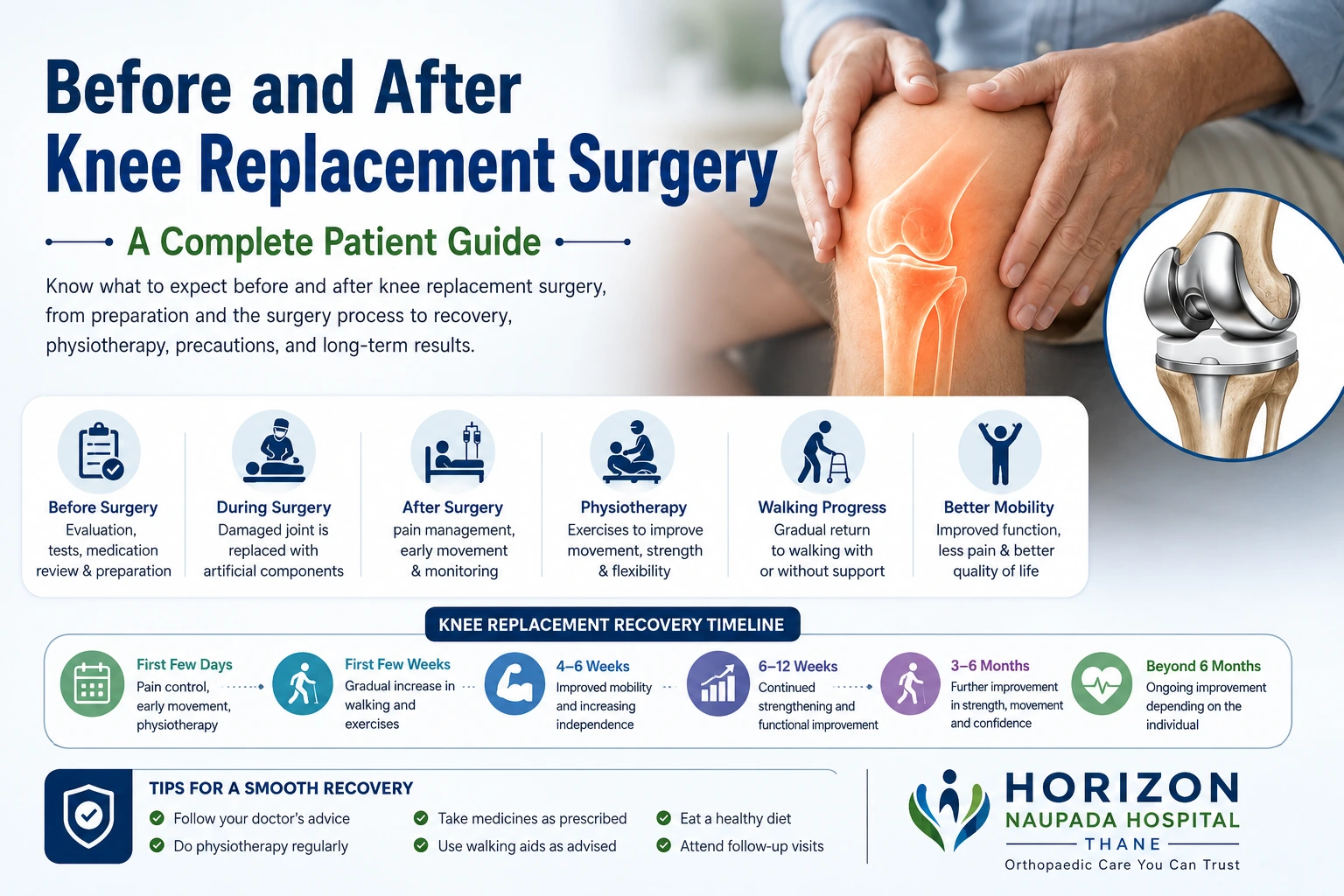
A simplified overview is:
| Before Surgery | After Surgery |
| Medical evaluation | Monitoring and pain management |
| Blood and other tests | Early movement |
| Imaging of the knee | Physiotherapy |
| Medication review | Gradual walking |
| Pre-surgery exercises | Increasing strength and flexibility |
| Home preparation | Follow-up appointments |
| Surgical planning | Gradual return to daily activities |
Let’s look at each stage in detail.
Before Knee Replacement Surgery
1. Medical Evaluation
Before knee replacement surgery, your orthopaedic surgeon will assess your symptoms, mobility, knee condition, medical history, and overall health.
The evaluation may include:
- Physical examination
- Knee X-rays or other imaging
- Blood tests
- Medical history review
- Medication review
- Assessment of other health conditions
- Anaesthesia evaluation
These assessments help the medical team determine whether you are medically prepared for surgery and identify factors that may affect recovery.
2. Medication Review
Tell your doctor about all medicines, supplements, and over-the-counter products you take.
Some medicines may need to be temporarily adjusted before surgery. However, patients should never stop prescribed medicines without medical advice.
Your surgical team will provide specific instructions based on your medications and medical history.
3. Strengthening Before Surgery
Pre-surgery exercises may help improve the strength and flexibility of the muscles around the knee.
Depending on your condition, your doctor or physiotherapist may recommend exercises targeting:
- Quadriceps muscles
- Hamstrings
- Hip muscles
- Calf muscles
- Knee range of motion
Patients should perform only exercises recommended by their healthcare team, particularly when knee pain is severe.
4. Preparing Your Home
Planning your home environment before surgery can make the initial recovery period easier.
Consider:
- Keeping frequently used items within easy reach
- Removing loose rugs and obstacles
- Creating a clear walking path
- Arranging a comfortable sleeping area
- Installing support rails where recommended
- Keeping essential items at an accessible height
You may also need temporary assistance with cooking, shopping, bathing, or other household tasks during the early recovery period.
5. Understanding the Surgery and Recovery Plan
Your surgeon should explain what you can expect during and after the procedure.
Ask questions about:
- The type of knee replacement planned
- Expected hospital stay
- Pain management
- Physiotherapy
- Walking assistance
- Wound care
- Follow-up visits
- Restrictions during recovery
- When you can resume specific activities
Having realistic expectations is an important part of preparing for surgery.
What Happens During Knee Replacement Surgery?
During knee replacement surgery, the damaged surfaces of the knee joint are removed and replaced with artificial components.
The procedure generally involves:
- Anaesthesia is administered.
- The surgeon accesses the knee joint.
- Damaged bone and cartilage are removed.
- The surfaces are prepared for the implant.
- Artificial components are positioned.
- The knee is assessed for movement and stability.
- The incision is closed.
The exact surgical approach and implant components depend on the patient’s condition and the surgeon’s assessment.
After Knee Replacement Surgery
The after knee replacement surgery period focuses on pain control, safe movement, preventing complications, restoring strength, and gradually returning to daily activities.
1. Early Movement
Patients are generally encouraged to begin moving the operated leg soon after surgery, according to their medical team’s instructions.
Early movement may help:
- Improve circulation
- Reduce stiffness
- Restore mobility
- Support muscle recovery
- Reduce the risk of certain complications associated with prolonged immobility
A physiotherapist will guide you through appropriate exercises and movement.
2. Physiotherapy After Knee Replacement
Physiotherapy is one of the most important parts of recovery.
The rehabilitation programme may include:
- Knee range-of-motion exercises
- Muscle-strengthening exercises
- Walking practice
- Balance exercises
- Gradual functional training
The exercises are usually progressed gradually according to the patient’s recovery.
Consistency is generally more important than trying to progress too quickly.
3. Walking After Knee Replacement
Many patients begin walking with assistance shortly after surgery, depending on their health and surgical recovery.
Initially, you may use:
- A walker
- Crutches
- Another recommended walking aid
As strength, balance, and confidence improve, the walking aid can gradually be reduced when your healthcare team considers it safe.
The timeline varies from person to person.
4. Pain and Swelling After Surgery
Some pain, swelling, bruising, and stiffness are expected during the early recovery period.
Your healthcare team may recommend:
- Prescribed pain medication
- Ice or cold therapy when appropriate
- Elevating the leg
- Gentle exercises
- Gradual activity
Follow your surgeon’s specific instructions regarding wound care, medications, and activity.
Knee Replacement Recovery Timeline
Recovery after knee replacement surgery is gradual. The following timeline is a general guide, not a fixed schedule.
| Recovery Stage | What May Happen |
| First few days | Pain control, early movement, physiotherapy |
| First few weeks | Gradual increase in walking and exercises |
| 4–6 weeks | Improved mobility and increasing independence for many patients |
| 6–12 weeks | Continued strengthening and functional improvement |
| 3–6 months | Further improvement in strength, movement, and confidence |
| Beyond 6 months | Ongoing improvement may continue depending on the individual |
Your actual recovery may be faster or slower depending on your health, age, muscle strength, surgical findings, and rehabilitation progress.
Before and After Knee Replacement Surgery: Key Differences
Patients often want to know how their daily life may change following knee replacement.
| Before Surgery | After Recovery |
| Persistent knee pain | Reduced joint pain for many patients |
| Difficulty climbing stairs | Improved ability to manage stairs |
| Stiffness | Better knee movement |
| Difficulty walking long distances | Greater walking capacity |
| Difficulty standing for long periods | Improved standing tolerance |
| Reduced participation in activities | Greater ability to perform everyday activities |
Knee replacement is primarily intended to relieve pain and improve function. It does not necessarily restore the knee to the same condition as a natural, healthy knee.
What Activities Should Be Avoided After Knee Replacement?
Your surgeon and physiotherapist will advise you about activities that are appropriate during recovery.
During the early healing period, you may be advised to avoid:
- High-impact activities
- Sudden twisting movements
- Excessive bending before adequate healing
- Heavy lifting without medical clearance
- Activities that cause significant pain or swelling
Low-impact activities may be encouraged once your doctor confirms that your recovery has progressed appropriately.
Warning Signs After Knee Replacement Surgery
Some discomfort and swelling can be normal after surgery, but certain symptoms require prompt medical attention.
Contact your healthcare team if you experience:
- Increasing or severe pain
- Significant redness or warmth around the wound
- Persistent or worsening wound drainage
- Fever
- Sudden increase in swelling
- Severe calf pain or swelling
- Shortness of breath or chest pain
- New difficulty moving the leg
Do not ignore symptoms that are severe, sudden, or worsening.
Tips for a Smooth Recovery After Knee Replacement
Following your medical team’s instructions can support a safe recovery.
Important recovery habits include:
- Attend scheduled follow-up appointments.
- Perform prescribed physiotherapy exercises regularly.
- Take medicines exactly as instructed.
- Keep the surgical wound clean and follow wound-care instructions.
- Use walking aids until your healthcare team advises that they are no longer needed.
- Increase activity gradually.
- Maintain a healthy weight.
- Avoid rushing back into strenuous activities.
- Report unusual or worsening symptoms promptly.
Frequently Asked Questions About Before and After Knee Replacement Surgery
How long does it take to recover from knee replacement surgery?
Recovery varies between patients. Many people gradually regain independence over several weeks, while improvements in strength, mobility, and confidence can continue for several months.
How soon can I walk after knee replacement surgery?
Many patients begin walking with assistance soon after surgery, depending on their condition and the surgeon’s instructions. A physiotherapist usually guides early walking and exercises.
Is physiotherapy necessary after knee replacement?
Physiotherapy plays an important role in restoring knee movement, strength, balance, and function after surgery. Your rehabilitation programme should be followed according to your healthcare team’s instructions.
Will knee replacement completely remove pain?
Knee replacement is designed to relieve pain caused by severe joint damage. Most patients experience significant improvement, but recovery and pain levels vary between individuals.
Can I climb stairs after knee replacement?
Yes, patients can generally return to using stairs as recovery progresses. Initially, you may need assistance or a specific technique recommended by your physiotherapist.
When can I return to normal activities after knee replacement?
The timeline depends on the activity and your recovery. Everyday activities may gradually resume over several weeks, while higher-impact activities may require longer or may not be recommended.
Conclusion
Understanding before and after knee replacement surgery can help patients approach the procedure with realistic expectations and better preparation. Before surgery, medical evaluation, medication review, physical preparation, and home planning can help you get ready for the procedure.
After surgery, pain management, early movement, physiotherapy, gradual walking, and regular follow-up are important components of recovery.
Every patient’s recovery is different. The most appropriate rehabilitation plan depends on your individual health, surgical procedure, mobility, and progress. If persistent knee pain is affecting your ability to walk, sleep, work, or perform everyday activities, an orthopaedic evaluation can help determine whether knee replacement or another treatment may be appropriate.
Horizon Naupada Hospital, Thane, provides orthopaedic evaluation and surgical services for patients with knee joint problems. Consult an orthopaedic specialist for an assessment based on your symptoms and medical condition.
Contact Details:
Address: Malati Mohan Bunglow, Telephone Exchange, Mahatma Gandhi Rd, opp. Naupada, Naupada, Thane West, Mumbai, Thane, Maharashtra 400602
Phone: 022 6124 2400
Website: horizonnaupada.com