What Causes Parkinson’s Disease? Understanding the Causes and Risk Factors
Parkinson’s disease is a progressive neurological condition that affects movement, coordination and several other functions of the body. It develops when certain nerve cells in the brain gradually become damaged or die, leading to a reduction in dopamine, a chemical messenger responsible for controlling smooth and coordinated movements.
Although Parkinson’s disease is commonly associated with older adults, it can also affect younger individuals. Symptoms may begin gradually and become more noticeable over time. While medical research has identified several factors associated with the condition, the exact reason why some people develop Parkinson’s disease remains unclear.
Understanding what causes Parkinson’s disease can help individuals recognise potential risk factors, identify early warning signs and seek appropriate medical advice. This article explains the possible causes, genetic and environmental influences, and factors that may increase the risk of developing the condition.
What Is Parkinson’s Disease?
Parkinson’s disease is a progressive disorder of the nervous system that primarily affects the areas of the brain responsible for controlling movement. It occurs when dopamine-producing nerve cells in a region called the substantia nigra gradually become impaired or die.
Dopamine plays an essential role in transmitting signals between different parts of the brain that coordinate body movements. When dopamine levels decrease, the brain has difficulty controlling movement efficiently.
People with Parkinson’s disease may experience symptoms such as:
- Tremors or involuntary shaking, particularly in the hands.
- Muscle stiffness and reduced flexibility.
- Slowness of movement, medically known as bradykinesia.
- Difficulty maintaining balance and coordination.
- Changes in walking pattern and posture.
- Smaller handwriting and changes in speech.
In addition to movement-related symptoms, some individuals experience constipation, sleep disturbances, depression, anxiety and a reduced sense of smell.
What Causes Parkinson’s Disease?
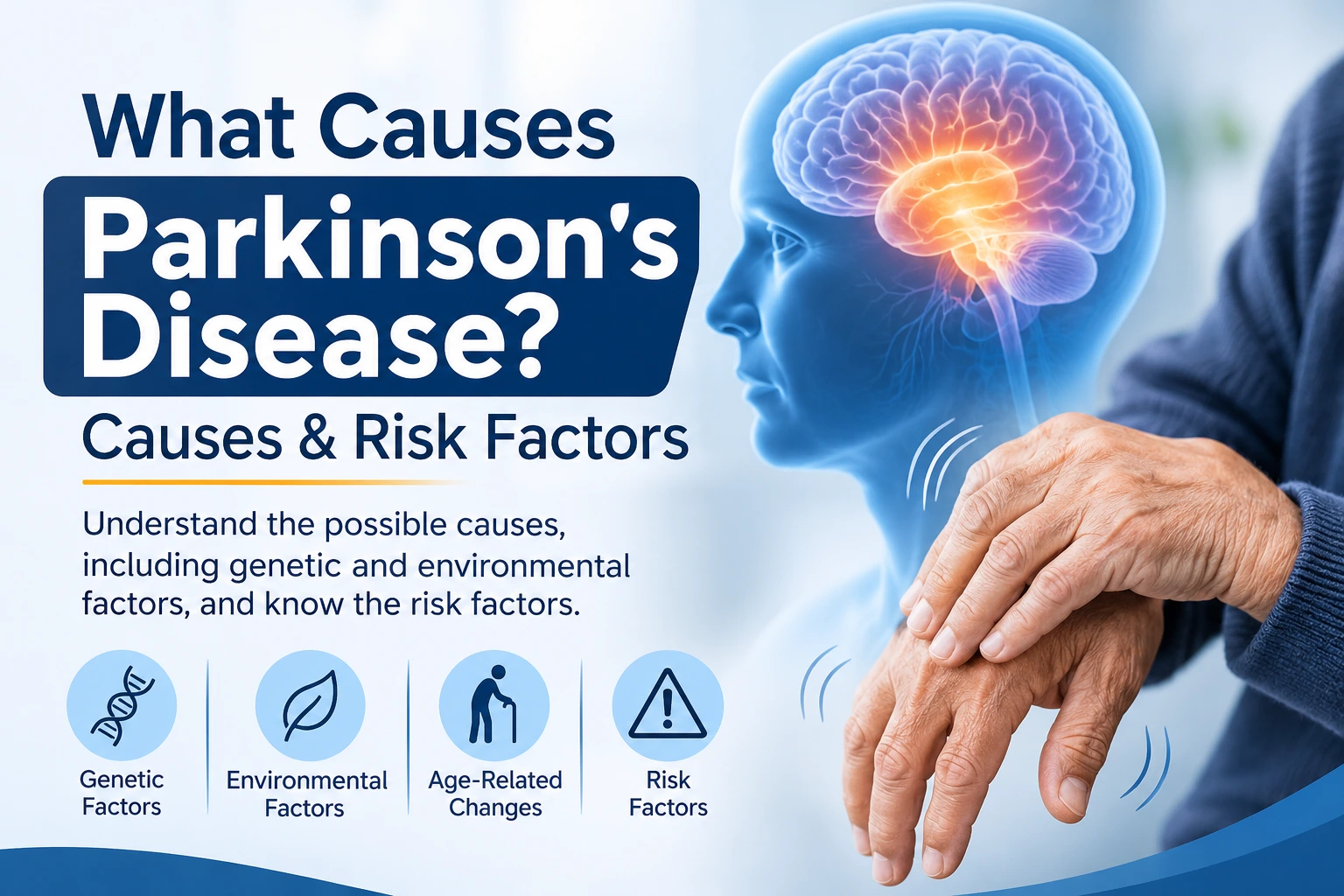
The exact cause of Parkinson’s disease is not completely understood. However, researchers believe that a combination of genetic, environmental and biological factors contributes to the development of the condition.
The disease develops when dopamine-producing neurons in the substantia nigra gradually degenerate. This reduces dopamine production and disrupts the communication pathways involved in controlling movement.
Several factors have been associated with this process.
1. Loss of Dopamine-Producing Brain Cells
One of the primary changes associated with Parkinson’s disease is the gradual loss of dopamine-producing neurons in the substantia nigra.
Dopamine helps the brain coordinate voluntary movements, maintain balance and control muscle activity. When these nerve cells become damaged, dopamine levels decrease, affecting the brain’s ability to regulate movement.
As dopamine production declines, individuals may develop:
- Resting tremors or shaking.
- Muscle rigidity and stiffness.
- Slower movements.
- Difficulty walking and maintaining balance.
- Reduced facial expressions.
These changes usually develop gradually. By the time noticeable movement-related symptoms appear, a significant proportion of dopamine-producing nerve cells may already have been lost.
2. Genetic Factors
Genetics can contribute to the development of Parkinson’s disease in some individuals. Certain genetic variations are associated with an increased likelihood of developing the condition.
Researchers have identified several genes that may influence the functioning and survival of brain cells. These include:
- LRRK2: Certain variations in this gene are associated with an increased risk of Parkinson’s disease.
- SNCA: This gene provides instructions for producing alpha-synuclein, a protein associated with abnormal protein accumulation in the brain.
- PARK7: Changes in this gene can affect the protective mechanisms that help brain cells manage cellular stress.
- PINK1 and PRKN: These genes play important roles in maintaining healthy mitochondria, which provide energy to cells.
However, having a genetic variation does not necessarily mean that a person will develop Parkinson’s disease.
Approximately 10–15% of Parkinson’s cases are associated with genetic factors, while most cases occur without a clearly identifiable inherited cause.
3. Environmental Exposure
Environmental factors may contribute to the risk of developing Parkinson’s disease, particularly when combined with genetic susceptibility.
Researchers have investigated several environmental exposures that may affect the health of dopamine-producing neurons.
These include:
- Pesticides and herbicides: Long-term exposure to certain agricultural chemicals has been associated with an increased risk of Parkinson’s disease.
- Industrial chemicals: Exposure to certain solvents and other industrial substances has been investigated for their possible association with neurological damage.
- Heavy metals: Some studies have explored whether prolonged exposure to certain metals may influence neurological health.
- Air pollution: Researchers are investigating whether long-term exposure to environmental pollutants contributes to neurodegenerative conditions.
It is important to understand that exposure to these substances does not automatically cause Parkinson’s disease. Their relationship with the condition is still being studied.
4. Age-Related Changes
Age is considered one of the most significant risk factors for Parkinson’s disease. The condition is more commonly diagnosed in people above the age of 60.
As people grow older, changes occur in the brain, including alterations in cellular repair mechanisms and the body’s ability to protect nerve cells from damage.
These changes may make certain individuals more vulnerable to the degeneration of dopamine-producing neurons.
However, Parkinson’s disease is not an inevitable part of ageing. Some people develop the condition before the age of 50, which is referred to as young-onset Parkinson’s disease.
5. Abnormal Protein Accumulation in the Brain
Another important factor associated with Parkinson’s disease is the abnormal accumulation of a protein called alpha-synuclein.
In healthy individuals, alpha-synuclein is involved in the normal functioning of nerve cells. However, in people with Parkinson’s disease, this protein can misfold and accumulate into clumps known as Lewy bodies.
These abnormal protein deposits are associated with changes in normal cellular functioning and are considered an important feature of Parkinson’s disease.
Scientists are continuing to investigate how alpha-synuclein accumulation contributes to nerve cell damage and disease progression.
What Are the Risk Factors for Parkinson’s Disease?
Although the exact cause of Parkinson’s disease remains unknown, certain factors may increase an individual’s likelihood of developing the condition.
The following table summarises some recognised risk factors.
| Risk Factor | How It May Influence Risk |
| Age | The likelihood of developing Parkinson’s increases with age. |
| Family history | Having close relatives with Parkinson’s may increase susceptibility. |
| Genetic variations | Certain inherited or acquired genetic changes are associated with the condition. |
| Environmental exposure | Long-term exposure to certain pesticides and industrial chemicals may increase risk. |
| Head injuries | Significant traumatic brain injuries have been associated with an increased risk. |
| Biological sex | Parkinson’s disease is diagnosed more frequently in men than women. |
Having one or more risk factors does not mean that someone will necessarily develop Parkinson’s disease. Similarly, people without any known risk factors can also develop the condition.
Can Parkinson’s Disease Be Hereditary?
Parkinson’s disease can sometimes run in families, but most cases are not directly inherited.
In a small proportion of individuals, specific genetic mutations are responsible for the development of the condition. These genetic changes may be passed from parents to children and can increase the likelihood of developing Parkinson’s disease.
However, most people diagnosed with Parkinson’s do not have a clear family history of the condition.
If several family members have developed Parkinson’s disease, a neurologist may recommend genetic counselling or testing in selected cases to understand whether inherited genetic factors could be involved.
What Are the Early Warning Signs of Parkinson’s Disease?
Recognising early symptoms is important because Parkinson’s disease can initially present with subtle changes that may be mistaken for normal ageing or other health conditions.
Some early warning signs include:
- Tremors: Slight shaking in the fingers, hands or other body parts, particularly when resting.
- Changes in handwriting: Handwriting may gradually become smaller or more cramped, a change known as micrographia.
- Reduced sense of smell: Difficulty identifying familiar smells may occur several years before movement-related symptoms.
- Sleep disturbances: Some individuals experience unusual movements, talking or acting out dreams during sleep.
- Constipation: Changes in bowel movements may occur as part of the non-motor symptoms.
- Muscle stiffness: Persistent stiffness may affect the shoulders, arms or legs.
- Changes in walking: Individuals may notice reduced arm movement, shorter steps or difficulty initiating movement.
These symptoms do not necessarily indicate Parkinson’s disease. However, persistent or unexplained changes should be evaluated by a qualified medical professional.
Can Parkinson’s Disease Be Prevented?
Currently, there is no proven method to completely prevent Parkinson’s disease. Since its exact cause is not known, researchers have not identified a guaranteed way to eliminate the risk.
However, maintaining overall health and reducing avoidable environmental exposures may support long-term neurological well-being.
Some general measures include:
- Regular physical activity: Walking, cycling, swimming and other appropriate exercises can support mobility, cardiovascular health and physical fitness.
- Balanced nutrition: Include vegetables, fruits, whole grains, protein sources and healthy fats in your daily diet.
- Avoid unnecessary chemical exposure: Follow appropriate safety precautions when handling pesticides, solvents and industrial chemicals.
- Prevent head injuries: Use appropriate protective equipment during activities that carry a risk of head trauma.
- Maintain regular health check-ups: Consult a healthcare professional about persistent neurological symptoms or concerns.
These measures support general health but should not be considered proven methods of preventing Parkinson’s disease.
When Should You Consult a Neurologist?
Early medical evaluation is important when a person experiences persistent tremors, unexplained muscle stiffness, changes in walking or increasing difficulty performing everyday activities.
A neurologist can assess symptoms, review medical history and perform a neurological examination to determine whether Parkinson’s disease or another condition may be responsible.
There is no single blood test that confirms Parkinson’s disease. Diagnosis is generally based on clinical symptoms and neurological examination. Additional investigations may be recommended when required to rule out other conditions.
Although Parkinson’s disease currently has no cure, appropriate treatment can help manage symptoms and improve quality of life. Treatment may include medications, physiotherapy, occupational therapy, speech therapy and, in selected cases, surgical procedures such as deep brain stimulation.
Conclusion
Parkinson’s disease is a complex neurological condition that develops due to the progressive loss of dopamine-producing nerve cells in the brain. Although the exact cause remains unknown, research suggests that genetic susceptibility, environmental exposures, ageing and abnormal protein accumulation may contribute to its development.
Understanding what causes Parkinson’s disease and recognising its early symptoms can help individuals seek timely medical evaluation. While the condition cannot currently be prevented or cured, early diagnosis and an appropriate treatment plan can help manage symptoms and support everyday functioning.
At Horizon Hospital, Naupada, Thane, individuals experiencing persistent movement-related or neurological symptoms should seek medical guidance for appropriate evaluation and care.
Medical Disclaimer: This article is intended for general educational purposes and should not be considered a substitute for professional medical advice, diagnosis or treatment. Consult a qualified healthcare professional for individual medical concerns.
Contact Details:
Address: Malati Mohan Bunglow, Telephone Exchange, Mahatma Gandhi Rd, opp. Naupada, Naupada, Thane West, Mumbai, Thane, Maharashtra 400602
Phone: 022 6124 2400
Website: horizonnaupada.com